
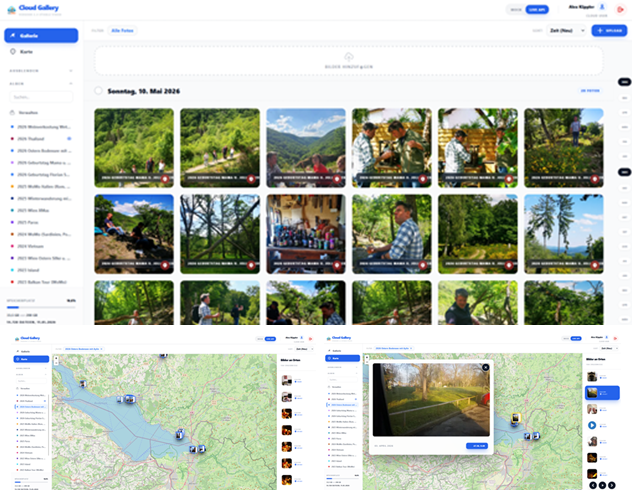
In early 2026, as AI continued to encroach further into our daily lives, I realized just how digitally dependent I had become. For this reason, I decided to stop storing my photos exclusively in the Google Cloud and instead set up my own private version of „Google Photos.“
Using AI and „vibe-coding“ (via Google AI Studio), I generated a Google Photos-like application through prompting. The frontend—that is, the look and feel—bears a resemblance to Google Photos, but is enhanced with features I had previously built years ago using Couno. This allows galleries to be easily shared with others (including the assignment of read/write permissions) and features a map view where I can display photos chronologically based on their embedded geo-coordinates. In presentation mode, I can thus relive those experiences while simultaneously seeing on the map exactly where they took place.
I did not entrust the backend (storage and data management) to the AI; it is written in PHP and essentially functions as a comprehensive API.
The same applies to the Android app—which facilitates the direct transfer of photos to the gallery (both automatically on a schedule and manually)—which I coded myself, albeit with the assistance and partial support of Google AI Studio.
To achieve greater digital independence, I host this entire „architecture“ on a Raspberry Pi 5 equipped with two hard drives, running within a private local environment—meaning no external cloud services and no recurring costs.