
Excited by AI and the initial reports about openClaw, I decided to take a look at it; I wanted to understand how it worked and what could be done with it. After the initial "wow" factor, however, came disappointment. In my view, the system is overly complex, involves a lot of overhead, and is incredibly powerful—perhaps dangerously so if you aren't careful. On top of that, it offers so many possibilities that it becomes overwhelming. I felt the same way I did back when the internet first became accessible to the average person: I’d launch the browser, stare at a blank page, and wonder, "What do I do now?"

It wasn't until search engines arrived that the World Wide Web truly opened up to me. I had a similar experience with openClaw: "What exactly am I supposed to do with this?" The few automation use cases that came to mind weren't things I wanted an AI to handle—and I certainly didn't want to send my data off to OpenAI, Claude, or anywhere else.

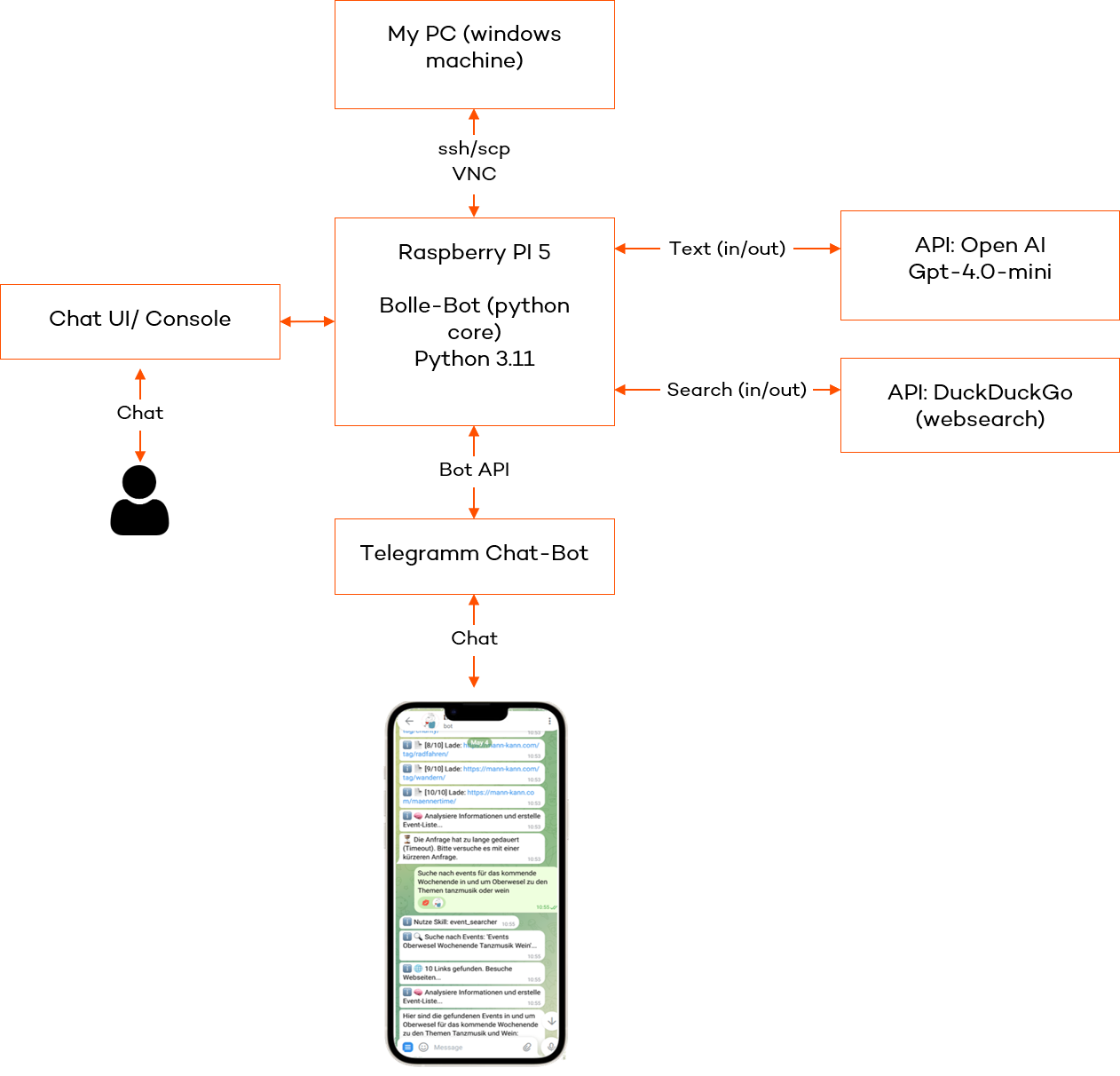
So, I examined how openClaw operates and built my own agent, "Bolle." Its architecture follows a similar pattern but is significantly simpler. Bolle’s core is written in Python and orchestrates various "skills" (others might call them "tools"—it makes no difference). Every request sent to Bolle is analyzed by an LLM. The LLM is instructed to identify the appropriate skill (or skills) for the request based on the available capabilities (which are part of the context). Each individual skill is also written in Python and uses input from the orchestrator (the core) to function. For instance, one skill might research the internet, while another could generate its own Python code if necessary. The skill's output is then fed back into an LLM call—potentially to trigger another skill that processes the previous result further. Finally, the results from the various skill executions are passed into a final LLM call to generate a coherent, well-formulated response. That’s it—nothing magical about it. After numerous attempts to run an LLM locally, I had to give up due to hardware limitations and am now using GPT-4.0-mini after all. It is relatively inexpensive and can actually provide structured responses (in JSON format) based on the provided context, making the output usable as input for the skills.

The bottom line: I really only use Bolle to remember things, research online, summarize content, or create lists. For anything beyond that, I don't trust the AI's accuracy enough to risk accidentally deleting or activating things I didn't intend to. And since Google Gemini or Claude can do everything Bolle currently does, for me, Bolle remains nothing more than a little toy.
However, it would truly come into its own if I gave it access to various APIs or system files. Then it could summarize long email threads, manage a shop system, build marketing campaigns, or generate analyses for me. If only I trusted the LLM enough...
E-Commerce Projects
Februar 2026
Agentic Workflows – my own openClaw
Februar 2025
Cash book WebApp

As the use of AI becomes more important, I wanted to create a small test project to see how well openAI Vision works and what the costs are for image recognition. This has now resulted in an application that offers real added value for me and many other people.
Yes, there are already plenty of cash book apps, but my cash book app uses AI to recognize what has been bought. The most annoying part of a cash book is always writing down and typing in purchases. And yes, every REWE, LIDL, ALDI & Co app offers us digital receipts, but unfortunately always in the respective store app. You can’t get an overview of a household, for example, that way.
And these are exactly the things that annoy me.
Both the typing and the store connection. The cash book webapp enables you to record purchases using a photo of the receipt and immediately assign them to a cash book. The receipts are retained digitally and can be viewed and downloaded at any time.
Cash books can also be used jointly (e.g. in a household). The use goes beyond simply recording receipts and evaluating budgets or statistics, because the sharing function enables the participants of a cash book (at an event where different people buy or buy things) to split the cash book and very easily calculate who has to pay how much and to whom. However, this is still determined using classic mathematics, without AI.
März 2023
Reminder App as a training project for agile software development

The app was basically started as a training project. The idea behind it was to create an app that could have various functions. The participants of the training put themselves in the position of the product owner and were then asked to jointly design and prioritize which functions the app should have per iteration.
I programmed many functions in advance (also in agile mode). They can be activated using feature flags, so that participants only had to wait 2-3 days for the new function, depending on their wishes. The training is over, I am still using the app.
So if you are interested in training in agile software development, please feel free to get in touch. The target group is not developers, but normal people who want to understand how agile software development actually works in real life.
What does the app actually do? – you can use the app to remember things, especially products. Then evaluate them for yourself and then, when you see the product again in the store and only know: „I know it“, but no longer „was it good or not?“, you can look it up in the app.
Dezember 2017
Google Skill and Facebook Chatbot

Chatbots and their embedding in Google, Amazon or Facebook have been all the rage for some time. The future of digital assistants is already here, it’s just that they still need to get a little better.
In order to get the difficulties, challenges and possible templates for further projects, I created an assistant or chatbot. The source for the data is roboter-testportal.de (see robot test portal), as images and texts are already available here. The anchor point of the bot is Dialogflow.
This control center accepts the requests from the various channels such as Google Assistant or Facebook and then forwards them (after evaluating the appropriate intent) to a web server (webhook). The webhook creates the response in the requested channel format and returns the result as a JSON response.
The output is then again via Dialogflow in the requesting channel.
I see the following as key results and findings:
- Understanding the intent mechanics Playing out logic in different channels
- Producing the correct JSON formatting for the individual channels
- Creating and launching Google Skill and Facebook Messenger Bot
The diagram shows the implemented workflow. All channels are bundled via Dialogflow (formerly api.ai).

Requests, regardless of the channel, come in here and are translated into intents by the existing AI or NLP engine. The processing of the intents themselves takes place in the backend/webhook. The result determined there is sent back to the sender by Dialogflow. This means that you can basically consolidate all requests in one logic. This has the advantage that you don’t have to process adjustments, extensions or bug fixing in different software solutions.
The programmatic implementation of response determination also makes sense because nobody really wants to manually enter new responses or content in Dialogflow. That would work too, but it is much more complex, especially if you want to display it for 1-n channels.
Dezember 2016
Certification „Adobe AEM 6 Business-Practitioner“
 The “AEM 6 Business Practitioner” exam was successfully completed in December 2016. The Business Practitioner certificate teaches the basic functions, use, structural design and options of the individual tools of the Adobe Cloud solution, in particular the CRM “Adobe Experience Manager”.
The main content of the certification consists in understanding the technical structure and technical options of the AEM system, which functions are possible and how they can be set up. The Business Practitioner is thus given the tools to act as a consultant for the Adobe AEM product at a business level.
August 2016
News-Feed Aggregator „Newshelden“
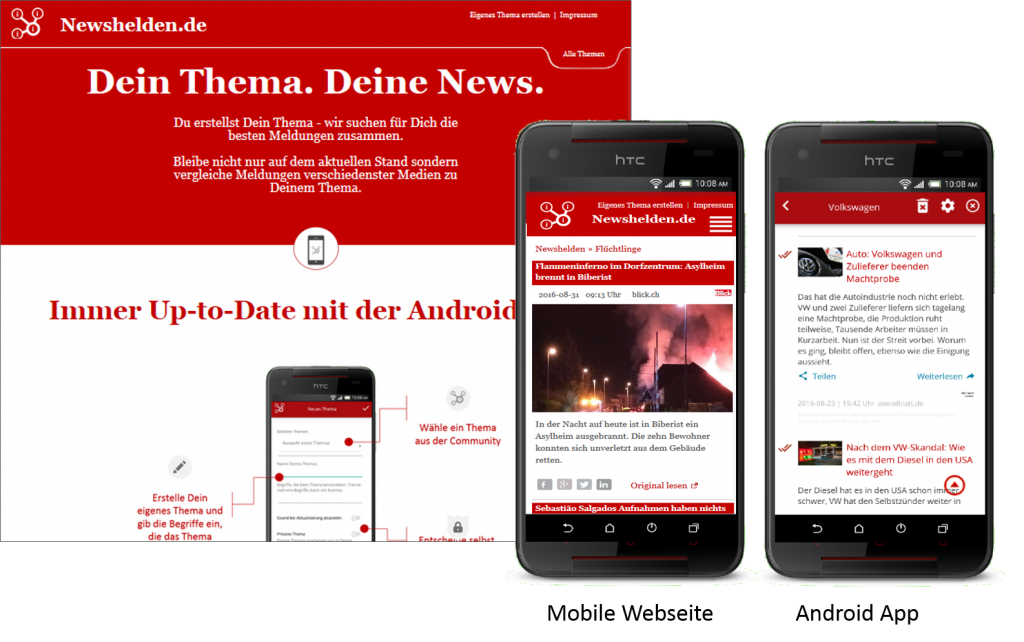
The News-Feed aggregator Newshelden.de is collecting news from more than 60 national (german) and international news-feeds. User may create their own topics with the representing keywords – we collect the news.
The newshelden-platform is an upgrade of the formerly developed Refugees-Germany-platform – but it deals with more information and with more than only one topic.
As well as for the refugee-project I developed an native Android-App, which works in more or less the same way as the mobile website (but also in offline-mode). Major benefit of using the App is, that the App is working as a kind of archive, because within that App, no news oder information will be automatically deleted. So people may monitor the change of tonality and information given, according their own topics. To make it more easy to start, the App offers some topics as first choice for the first usage.
I wish you fun and more information-transparency by using the App or the website – so feel free to send me an email if you have any concerns. Please consider, I develop website and App in my spare time, so I do not have unlimit time and budget for further steps…
[bis]today[/bis]
August 2015
Business Modell and Pilot-Project for a innovative Display-Marketing-Platform
 SPOTvertising is some kind of a new and innovative Display-Marketing platform. The idea as well as the complete realization and implementation was done in 2015. SPOTvertising combines Display-Marketing with free WLAN-Hotspots for local targeting and local commercials other then print. Customers can upload their display-ads and decide, in which of the connected WLAN Hotspots the ads should be displayed. The pilot-project was ignited in Oct 2015, with one single free WLAN Hotspot, to ensure propper functionality and to test resonance of people connecting the free WLAN. Later, if I have the proof of resonance and customer engagement, the project might be easily rolled out over an unlimited amount of WLAN-Hotspots.[bis]today[/bis]
März 2015
Platform to join media
 Couno.de is a platform, in which different users can upload media (pictures, videos) from an event, they visited together. This time, everybody shares its videos and pictures, but couno.de joins them again, to get a wider view onto an event, with the pictures of everybody joined in on the platform. The platform is able to track the geo-coordinates of the images so it becomes possible to plott a complete journey with map-display and innovative presentation-mode. To make the upload as easy as possible, I created a Java-Upload-Tool for desktop-PC and a native android app.[bis]today[/bis]
August 2014
Conception, planning, realization and maintaining an affiliate platform „Roboter-Testportal“

The „Roboter-Testportal“ is an affiliate portal. I summarize the comments and reviews of different home-robots to give an overview about their performance and test-reports, so people do not have to read a lot of different websites to summarize and find a decission, which roboter to buy. I aggregate a lot of test-reviews to give the visitor the best content about each roboter.[bis]today[/bis]
Juni 2013
Conception, business-modelling and realization of Smartviewer.de

Smartviewer acts as an innovative e-commerce and multichannel platform to digitalize shop windows of physical stores. Main innovation is, that passersby may interact with the shop window. The Smartphone of the passersby becomes to a virtual remote control for the window – so they can control the window-display and the content within by their own device. But thats not enough – I thought the process some steps further to make it more senseful to interact with the shop window. Pilot-phase started in july 2014.[bis]today[/bis]
November 2012
Multiimprint – centralized administration and multi-usage of one imprint in several different websites

Because of the fact that I own and manage several different websites, I got the problem loosing control about the imprints on the different websites (some sites are abandoned, others are new projects). I decided to create a tool to administrate only one imprint with all neccessary data and use that in any website I run later on. Multiimprint is useable for 1-n domains for 1-n clients and provides proteced data to any specific domain in realtime.[bis]today[/bis]
September 2012
Concept and realization of a congress survey voting tool

Smartvoting is an alternative voting-tool for surves at large events with a lot of guests and participants. The Smartphone of any guest itself becomes the voting-device, the result-display is connected to powerpoint or any kind of website-integration. The moderator has full control about the voting, may stop and reset the result as well as closing the survey. The amount of participants is unlimited. Idea and realization within the scope of my contract with elaboratum GmbH – multiple deployments in live environments are beeing done sucessfully.[bis]today[/bis]
Januar 2011
Creation of a location based services und mobile WebApp-platform

Conception and business-modelling of lokality.de. Lokality.de was created to help small business companies with just a small website to deliver a smartphone-optimized view to web-visitors. Cliensts of lokality.de could create their own „smartphone-ready“ website-profile, including colors and icons. The content was scraped from the original web-page and included into the lokality.de-profile. By that wy, customers got a smartphone-optimized view of their own website, without much efford and without the multiple management of content.
The complete business model was designed for a duration of two years, the market development of responsive websites was obvious – after two years, there would be no further need for such kind of mobile website display.[bis]today[/bis]
Januar 2009
WordPress development for MVV-Blog

Co-Founding and programming of the watch-blog www.mvv-blog.de. First WordPress-project with the aim to write about the local transportation agency. Basically developed as SEO-Test site, the blog grew to an actively commented and well visited website – and is still beeing used by myself to test some local SEO-strategies or recently developed WordPress-plugins.[bis]today[/bis]
August 2008
Realization SEO-Analysis Tool „SRPP“
Concepted and developed at the beginning of 2009. The Web-platform uses techniques like JAVA, Javascript and PHP to scrape the google search result page. Main focus was to get positions and listings for keywords in relation to my clients websites. The tool did all the scraping and crawling on its own, the web-view was used as maangement- and reporting-interface. With the german market entry of tools like SISTRIX or silmilar and in combination with the always changing google listing algorythms, I stoppted further development of the tool, because of the lack of time to permanently adjust the routines and logics.[bis]October 2013[/bis]
Juli 2008
Realization SEO-text optimization-tool
OptiHead is a small software, which analyses a given text in order to find the best headline for the text. The tool provides some keyword-calculations and visualizes the matching of a given headline to the given text. OptiHead is primarily designed as agency-tool for online-editors. While increasing my WordPress-development scope, I made a plugin of the code to integrate it in any wordpress-installation.
Dezember 2007
Search engine optimization of online-shops and websites
As part of the spare-time self-employment I coach and train clients to write search-engine-friendly content. I also create on-page optimization for small business companies on demand, which includes the programming of SEO-basics such as clean code, meta-information-management or landing-page design and implementation.[bis]today[/bis]
August 2007
Founding of conmasys
Conmasys was founded as stand-alone CMS. As conmasys was created and developed, the german market concerning content management systems was very rare. Therefore I decided to develop my own CMS, sold it to customers and optimized the system for all known SEO-purposes. The development decreased with my increasing consulting activites and with the market entry of more functional CM-Systems like Typo3, WordPress or Joomla. Since 2011 the conmasys CMS is abandoned and replaced by WordPress but the label „Conmasys“ is still in use for all self-employment ativites.[bis]today[/bis]
Juli 2007
Founding business-idea „netask.de“
Netask.de was the realization of the busniess-idea of „online surveys“. At the beginning of 2006 there where 3 or 4 relevant competitors in germany, so I developed the business-model and realized the web-survey, which could be easily integrated in any other website (which was the main selling proposition). The realization was the result of my participation in the munich business-plan competition whily studying business-informatics in munich. The project has been ceased to get more capacities for more profitable projects – the domain ist still in my account… you never know… [bis]October 2013[/bis]
Februar 2007
Successful participation at Munich businessplan competition
Sucessful participation at the munich businessplan competition with the idea of online-surveys, which can be easily integrated in any website, without loosing functionality or layout. The project has ceased Oct 2013, the label and domain is still in my account.
Oktober 2006
Newsletter-development und publishing
Creating and publishing of the marketmarket.eu – newsletter (www.marketmarket.eu). Main tasks where layouting and coding the HTML/Text-Version of the newsletter, management of the delivery, tracking and reporting afterwards.[bis]October 2008[/bis]