
Excited by AI and the initial reports about openClaw, I decided to take a look at it; I wanted to understand how it worked and what could be done with it. After the initial "wow" factor, however, came disappointment. In my view, the system is overly complex, involves a lot of overhead, and is incredibly powerful—perhaps dangerously so if you aren't careful. On top of that, it offers so many possibilities that it becomes overwhelming. I felt the same way I did back when the internet first became accessible to the average person: I’d launch the browser, stare at a blank page, and wonder, "What do I do now?"

It wasn't until search engines arrived that the World Wide Web truly opened up to me. I had a similar experience with openClaw: "What exactly am I supposed to do with this?" The few automation use cases that came to mind weren't things I wanted an AI to handle—and I certainly didn't want to send my data off to OpenAI, Claude, or anywhere else.

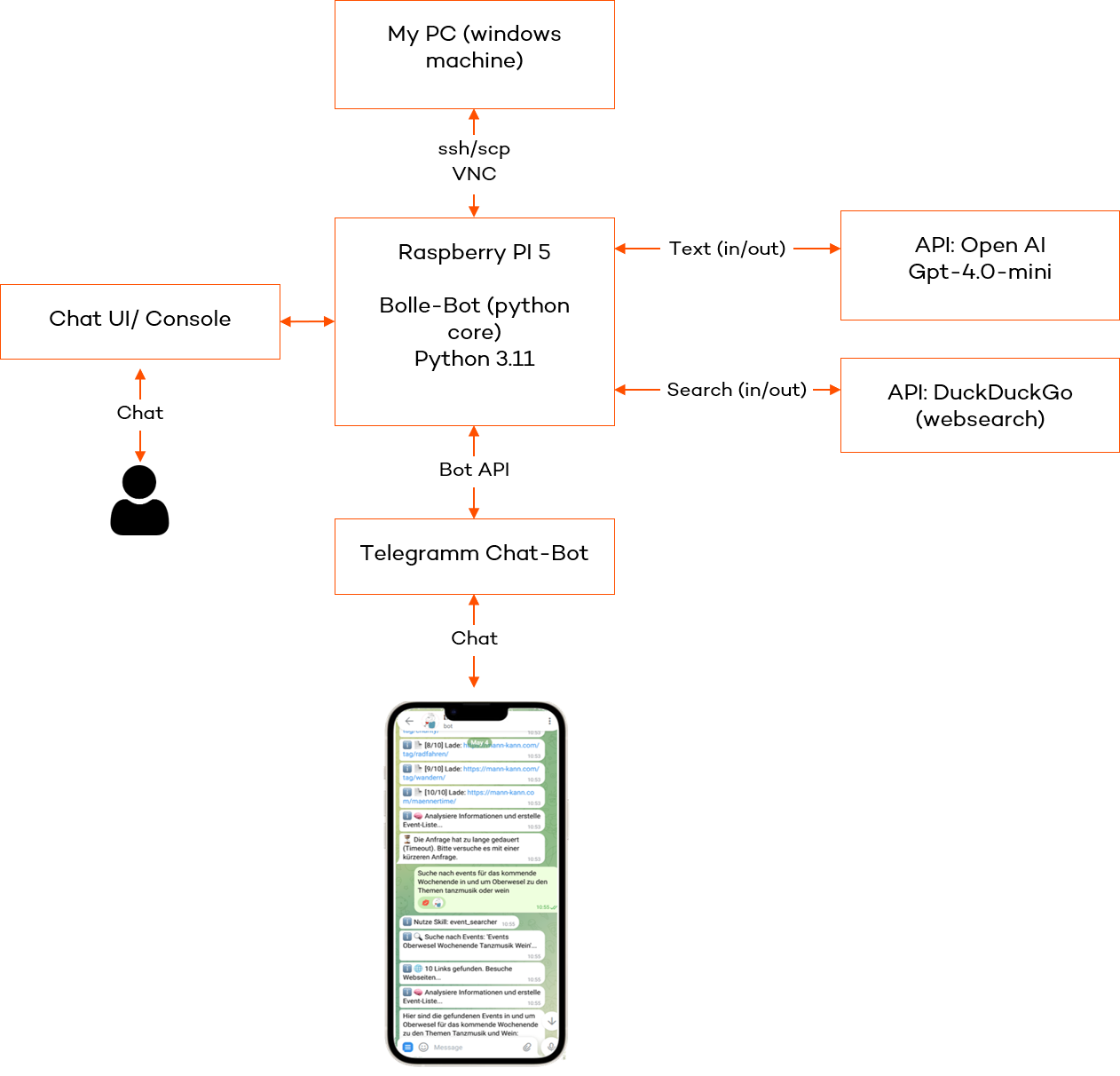
So, I examined how openClaw operates and built my own agent, "Bolle." Its architecture follows a similar pattern but is significantly simpler. Bolle’s core is written in Python and orchestrates various "skills" (others might call them "tools"—it makes no difference). Every request sent to Bolle is analyzed by an LLM. The LLM is instructed to identify the appropriate skill (or skills) for the request based on the available capabilities (which are part of the context). Each individual skill is also written in Python and uses input from the orchestrator (the core) to function. For instance, one skill might research the internet, while another could generate its own Python code if necessary. The skill's output is then fed back into an LLM call—potentially to trigger another skill that processes the previous result further. Finally, the results from the various skill executions are passed into a final LLM call to generate a coherent, well-formulated response. That’s it—nothing magical about it. After numerous attempts to run an LLM locally, I had to give up due to hardware limitations and am now using GPT-4.0-mini after all. It is relatively inexpensive and can actually provide structured responses (in JSON format) based on the provided context, making the output usable as input for the skills.

The bottom line: I really only use Bolle to remember things, research online, summarize content, or create lists. For anything beyond that, I don't trust the AI's accuracy enough to risk accidentally deleting or activating things I didn't intend to. And since Google Gemini or Claude can do everything Bolle currently does, for me, Bolle remains nothing more than a little toy.
However, it would truly come into its own if I gave it access to various APIs or system files. Then it could summarize long email threads, manage a shop system, build marketing campaigns, or generate analyses for me. If only I trusted the LLM enough...
Training and Development
Februar 2026
Agentic Workflows – my own openClaw
September 2018
professional scrum product owner

Certification as professional SCRUM Product Owner via scrum.org
Mai 2015
Leadership-Training

Three day seminar „Process Communication Model“. The communication model helps to understand the way, people communicate with each other. I learned about myself, why I react as I do, and why other people act and re-act as they do. Finally the seminar is the first step to actively manage the communiation, reaching own conversion-goals without to pique the dialogue partner.
Januar 2014
Communication training – pyramidial presentation

Two-day seminar. Usage of differnet techniques to create meaningful presentations with an understandable and logic structure. The pyramidial presentation method can be used to structure projects, conversations, negotiations and presentations.
Januar 2014
Advanced Training in using the web- prototyping tool Axure

Two-day introduction and training in the prototyping software „Axure“. Axure is beeing used to create wireframes, process-visualization and clickdummies for websites and webshops prior to develop them as real HTML-Version.
April 2013
Communication-Training
Two-day seminar to increase my communication skills for diplomatic conversations. Content of the seminar was the training of different techniques to understand the reason and motivation of the conversion partner, to react adequately and conversation-goal-oriented.
März 2009
Coaching and initiation of agile projectmanagement
Internship at adtraffic GmbH, Munich while studying. Together with a coach I initiated the agile projectmanagement method „scrum“ to manage projects and software development, created a virtual server architecture for internal test-purposes and documentation, coordinated the developer-team in Croatia.[bis]May 2009[/bis]
Dezember 2006
UNIcert-III english
Training and completion of the UNIcert III-certificate in english at the University of applied sciences in Munich.
Dezember 2004
MCP – Microsoft Certified Professional
Microsoft Certified Professional: management and support for a Windows-2003-Server Domain.
November 2003
LINUX Basic-Training
Introduction and basic training in the linux system „Debian-Linux“. Contents are basic filestructure, console commands and basic understanding of the linux system-architecture. I used a lot of those learnings for my own server-architecture afterwards, as well as for the setup of some Raspberry PI – Systems years later.
Februar 2002
Advanced Air-Combat Training for Fightercontrol

Advanced training in aircraft control for air-combat in the scope of tactical air defense. Finalized with the „combat ready“ – qualification.
November 2000
Airforce Officer Leadership Training
Ability to lead groups up to 30 members in object-defense szenarios. Advanced teaching methods.
August 1999
Language training english
The english training was part of the officers-traning, finished with the NATO-Language profile 3332.